FG and Opposition Clash Over Alleged N8.8trn “Off-Budget” Spending
By Victor Idajili
The Federal Government is facing fresh questions after the IMF raised concerns about about N8.8 trillion in public spending that it says was not properly captured in Nigeria’s official accounts.
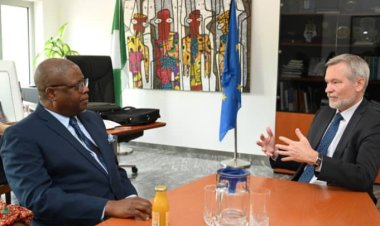
Speaking in Lagos, IMF Resident Representative Christian Ebeke said roughly 2% of government expenditure was not reported in the country’s fiscal records.
Using Nigeria’s rebased 2025 GDP of about N441.5 trillion, that 2% equals roughly N8.83 trillion.
Ebeke explained that the gap comes mainly from capital projects done outside the main budget. Because they were not in approved budget documents or in implementation reports, he said Nigeria’s real fiscal deficit looks smaller than it actually is.
“About two per cent of expenditures were not reported that should be reported and should be recorded, so that this statistical discrepancy will disappear,” he said.
He warned that off-budget spending makes it harder for fiscal and monetary authorities to coordinate, and raises issues around accountability, procurement and oversight.
He, however, noted that government is already working on legal reforms to bring such spending into the formal budget.
Opposition leaders seized on the IMF comments.
Former Vice President Atiku Abubakar called the report “deeply disturbing.” He alleged it points to a “parallel fiscal structure” running outside National Assembly oversight.
“If trillions of naira were indeed spent without being fully reflected in official budget documents, it would raise serious constitutional and governance concerns,” Atiku said.
He asked the National Assembly to hold hearings, and urged the Auditor-General, EFCC and ICPC to investigate. He also claimed about N800 billion had been deducted from state allocations without clear explanation and should be refunded.
Atiku further alleged that the Tinubu administration is “awarding multi-trillion naira contracts... entirely beyond the reach of the Auditor-General, the nation’s procurement laws, and the legitimate oversight of the National Assembly.”
He linked the pattern to what he described as Lagos State’s fiscal approach under Tinubu as governor.
ADC presidential candidate Peter Obi went further, renewing his call for President Tinubu to resign. He said N8.83 trillion is more than one-third of the capital budget, and bigger than the combined allocations for health and education.
“Resources of such magnitude, if transparently managed, could have significantly transformed key sectors of the economy,” Obi argued, saying the development proves his criticism that the government has not tackled poverty, unemployment and inflation.
FG fires back: “No shadow budget”
The Federal Government denied the claims.
Finance Minister Taiwo Oyedele said reports of secret N8 trillion spending are “inaccurate and misleading.” He stressed that the Constitution governs how public funds are withdrawn, and that all federal spending follows Appropriation Acts and other laws passed by the National Assembly.
According to the ministry, items like multi-year projects, statutory transfers, intervention funds and first-line charges are legal and may just be reported differently under international standards. That, he said, does not mean the money was spent illegally.
Oyedele also said the IMF’s concern is about better reporting and transparency, not about illegal spending. He explained that the fiscal deficit depends on revenue vs expenditure, not just how figures are presented.
Economist Dr. Marcel Okeke said the controversy hurts Nigeria’s image.
“This shows the level of corruption in the system or some kind of inefficiency... This kind of story de-markets the country a lot, both locally and globally,” he said.
He called for the government and IMF to reconcile their figures. He also warned that with elections months away, the timing raises suspicion that funds could be used as a “war chest.”
“The government should do everything to come clean,” he added.