Chagos Sovereignty No Longer Up For Debate, Says Mauritius, After Trump Criticises UK Deal
By Victor Idajili
Mauritius’ attorney general has responded to Donald Trump’s criticism of the Chagos deal, stressing that it still expects the agreement to go ahead.
In the written statement, Gavin Glover says it is “important to remember” that the deal was “negotiated, concluded and signed exclusively between the United Kingdom and the Republic of Mauritius”.
“The sovereignty of the Republic of Mauritius over the Chagos Archipelago is already unambiguously recognised by international law and should no longer be subject to debate,” it says.
"We expect the treaty to be implemented as soon as possible, in accordance with the commitments made."
The government’s opponents argue that giving up the Chagos Islands represents an act of national self-harm and a boost to the United Kingdom’s rivals, especially China.
The arguments include an element of post-imperial hand-wringing but also the fear that the base at Diego Garcia, vital to both the UK and United States, will soon be more vulnerable.
The base’s remote location makes it extremely difficult to monitor, except from space.
But if Mauritius decides to open up the waters of the Chagos archipelago to commercial fishing, this could change.
“Beijing uses its fishing fleet as the eyes and ears of its military,” Jack Watling of the Royal United Services Institute wrote in November 2024.
“There is a significant risk that such vessels will soon ply the waters around the base.”
If such concerns were shared by in Washington, there was little sign of it last summer when US Secretary of State Marco Rubio spoke in glowing terms of what he called “this monumental achievement”.
In February last year, Donald Trump said he had “a feeling that it’s going to work out well”.
It’s not clear why he seems to have changed his mind so dramatically.
Donald Trump's post on his Truth Social platform earlier positioned the Chagos Islands deal as a matter of national security for America, referring to Diego Garcia as "the site of a vital US Military Base".
The US launched a huge construction project on the island in the 1970s and spent 10 years turning it into a fully operational military airbase.
The site, and operations there, are highly secretive.
Here are some of the operations it has been involved in before:
During former US President George W. Bush's so-called War on Terror, following the 9/11 (11 September) attacks, US stealth bombers would stop off at Diego Garcia as they returned from bombing-runs of al-Qaeda targets in Afghanistan.
It was later a key base for US and UK operations during the Iraq War.
Troops and bombing aircraft were stationed there, as well as the giant US Navy hospital ship USNS Comfort.
More recently, in May 2025, satellite imagery from Earth data analytics company Planet Labs showed that the Pentagon had deployed bombers to the island.
This came after the US ramped-up its bombing campaign against the Houthi rebel group in Yemen and amid tensions with Iran
Downing Street has said the US still supports the deal to hand sovereignty of the Chagos Islands to Mauritius, despite President Trump calling it "an act of great stupidity".
The prime minister's official spokesperson says: "Our position hasn't changed on Diego Garcia or on the treaty that's been signed."
"The US supports the deal and the president explicitly recognised its strength last year," they say.
"All our Five Eyes allies support it too and they all understand the national security capabilities that the base provides."
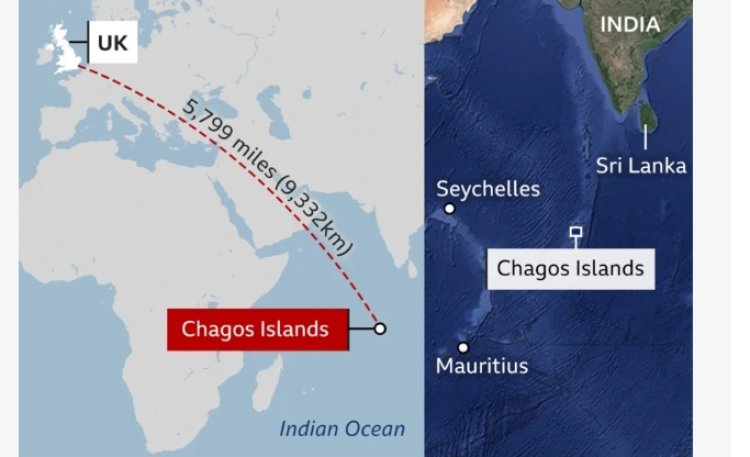
When the UK took control of the Chagos Islands - Diego Garcia is the southernmost - from former British colony Mauritius, it sought to rapidly evict its population of more than 1,000 people to make way for the military base.
Chagossians have described being herded on to cargo ships and taken to Mauritius or the Seychelles.
Many people born on the Chagos Islands and their descendants have gone on to live in the UK, where they have been granted citizenship.
Chagossians do not speak with a united voice on the fate of their homeland, but many in the UK oppose the deal with Mauritius, saying that it ignores their rights.