Almajiri Commission Budgets N8.4bn for Roads Despite Not Being Part of Its Mandate
By Victor Idajili
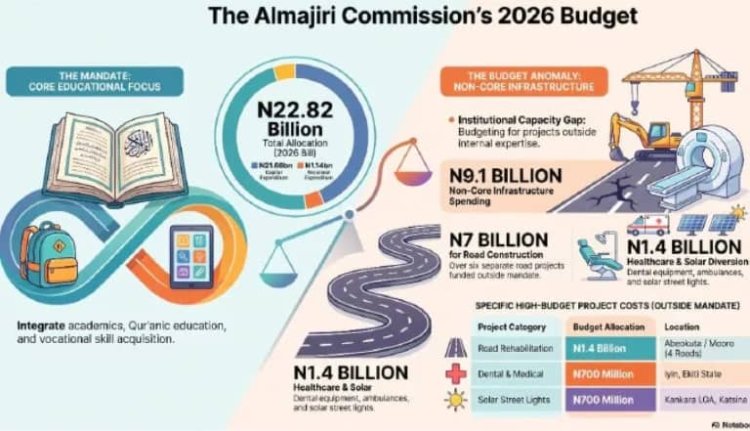
The National Commission for Almajiri and Out-of-School Children Education has set aside N8.4 billion in the 2026 budget for road construction and other projects that fall outside its core responsibility.
According to details in the 2026 Appropriations Act, the commission got a total allocation of N22.82 billion — N21.68 billion for capital projects and N1.14 billion for recurrent spending.
Aside from roads, the agency also budgeted for ambulances, medical equipment and solar power installations in Ogun, Ekiti and Katsina states.
The commission was created by an Act of Parliament on May 27, 2023, under the Federal Ministry of Education.
Its job is to tackle the out-of-school children crisis by integrating formal, Qur’anic and skills-acquisition education.
Under the National Policy on the Enhancement of Almajiri Education, it is expected to:
- Coordinate and oversee Almajiri education nationwide
- Register teachers and learning centres with state governments
- Provide scholarships, school feeding, learning materials, and help end street begging
- Train teachers, supervise centres, and enforce child protection laws
- Work with UBEC, SUBEB, NBTE, NDE and NERDC to deliver basic and vocational education
Roads, solar street lights and medical equipment are not listed in that mandate. Those responsibilities belong to the Federal Ministry of Works, FERMA, and health agencies.
Budget and accountability experts say inserting such projects into the commission’s budget is “mandate distortion” that weakens oversight and takes money away from education.
The commission earmarked funds for several road and non-education projects:
Ogun State – N3.85bn
N1.4bn for Eyinni High School-Lusada Junction, Idiya Central Community, Ile Ise-Asuje and Soyoye Community roads in Abeokuta
N1.05bn for Pakoiji-Iporan Township Road, Ipokia
N1.4bn for Obasanjo Itele, Nazareth, Oke Ola, Imeko, Idogo and Odedeyo-Mewuro roads
Katsina State – N2.8bn
N1.05bn for internal roads in Dan Marke
N1.05bn for internal roads in Sabon Gari Yargoje, Sharada Burburga
N700m for 3-in-1 solar street lights in Danmarke, Jamruwa, Gidan Chindo and Sabon Gida, Kankara LGA
N700m for women and youth empowerment tools in Kankara
Ekiti State – N2.1bn
N1.4bn for internal roads within Government Science College, Iyin
N700m for ambulances, furniture, dental X-ray machines and dental chairs for a dental centre in Iyin
A source at the Budget Office said ministries and agencies submit their own proposals, and the office only collates them. The source added that many “off-mandate” projects are inserted during the National Assembly stage as “constituency projects.”
“When lawmakers can’t fund projects directly, they use agencies as proxies. If the agency refuses, its budget can be delayed or blocked,” the source said.
A Senate source also confirmed the practice is common: “If a lawmaker gets an approved constituency project, the execution must be done through any federal agency, irrespective of the mandate of such agencies.”
Civil society groups have criticised the move.
Auwal Musa Rafsanjani of CISCLAC/Transparency International Nigeria said assigning roads to an education commission undermines institutional focus and makes it hard to track performance and value for money.
“Road construction is ordinarily the responsibility of agencies with the technical expertise and statutory authority to execute infrastructure projects,” he said. He called for a review and for the Auditor-General and anti-corruption agencies to scrutinise the allocations.
Dr. Umar Yakubu of the Centre for Fiscal Transparency said the commission should focus on Nigeria’s estimated 20 million out-of-school children instead.
“They have nothing to do with road construction. What they are supposed to do is ensure that the number of out-of-school children begins to decline year after year,” he said. He warned the commission risks becoming “another pipeline to satisfy some politicians.”
Ibrahim Yusuf of the Gombe Network of CSOs called it “misplaced priority” and said the trend reflects weak oversight by the National Assembly.
“How can the Almajiri Commission be constructing roads? What is the rationale behind this?” he asked.