Fuel crisis deepens, economists tell FG to act
By Victor Idajili
. .
Economic and energy experts have called on the federal government to take immediate steps to cushion the effect of the rising cost of petroleum product triggered by the ongoing war in the Middle East which has disrupted global oil supply chains and driven crude oil prices upward.
The price of petrol has continued to climb steadily, raising fears that it could soon hit N2,000 per litre if global oil market volatility persists.
As a country that still depends significantly on imported refined petroleum products, Nigeria has been directly affected by the rising international prices.
This is despite the existence of Dangote Refinery which has contributed to local refining. However, the facility has responded to the rising crude prices by continuously adjusting its pump price in line with the current realities.
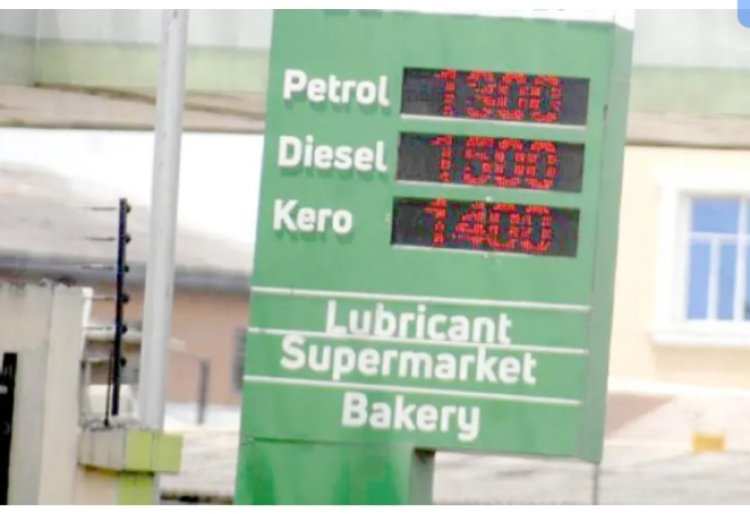
Although the refinery yesterday reduced its gantry price by N100 to N1,075 per litre, this has not reflected in the pump price as of the time of this report as Nigerians reported buying the product at over N1,300 per litre in parts of the country.
Industry operators and economists have warned that if the current global oil market conditions persist, the pump price of petrol in Nigeria could continue to rise sharply, worsening the country’s already difficult cost-of-living situation.
Across several states, petrol prices have surged dramatically in recent days, with many filling stations selling the product at between N1,200 and N1,350 per litre; while some independent marketers have hinted that further adjustments are inevitable.
The development has elicited widespread concern among Nigerians who say the rising fuel prices are pushing up transportation costs, food prices and business expenses beyond their reach.
An economist at Sa’adatu Rimi College of Education, Dr. Abdussalam Kani, urged the federal government to adopt practical measures to reduce the rising cost of transportation and fuel in the country.
Kani, who lectures in the Department of Economics at the college, said one of the options is for the government to collaborate with the Dangote Refinery to refine crude oil for domestic consumption at subsidised rates.
He said the government could allocate a certain quantity of crude oil to the refinery to process on its behalf, which would then be supplied to filling stations at lower prices for Nigerians.
“If the government can provide a specific quantity of crude oil to Dangote Refinery to refine on its behalf, the refined petroleum products can then be distributed to filling stations at subsidised prices,” he said.
The economist also advised the government to introduce subsidised public transportation by deploying buses at designated locations for civil servants, students and other commuters.
According to him, such vehicles could operate from strategic points in cities and towns to reduce the burden of transportation costs on the public.
Kani further recommended expanding the use of vehicles powered by Compressed Natural Gas (CNG), noting that the initiative could significantly lower transport expenses.
He said the government should procure more CNG-powered vehicles and deploy them within the public transport system to provide cheaper alternatives for commuters.
Also, Prof. Dayo Ayoade, Energy Law expert at the University of Lagos, said the price hike is a matter of international events and not necessarily domestic.
He said there is limit to what the federal government can do to cushion the impact on Nigerians.
He, however, said in the short term, “you could say the government could increase the money it gives in terms of targeted cash transfers to the poorest in society.”
“My own view is that if the register is correct and it is cleared of fraud or cleared of manipulation, if you can access this and do that, then that would be good.”
An economist at the University of Ilorin, Prof. Gafar Ijaiya, advised the government to “collaborate with Dangote. In that case, any form of support should be directed at crude supply so that the refinery can access crude at a relatively stable price. That will help achieve price stability,” he said.
Ijaiya explained that subsidising imported petroleum products would only reopen the era of rent seeking and corruption that previously characterised the fuel subsidy regime.
“If the Dangote refinery had not come on board, Nigerians would probably have been buying fuel for around N2,000 to N3,000 per litre,” he added.
An economic analyst, Samuel Caulcrick, urged the Central Bank of Nigeria to intervene in bringing down the cost of dollar exchange to Naira, saying this would lower the cost of fuel.
“By now, the price of fuel would have been reduced. But again CBN didn’t want the Naira to fall so badly because they didn’t want investors who brought in dollars to start withdrawing their money. That is why they intervened and started buying dollars from the market so that the price would not fall so fast.
“So any country that doesn’t have a fixed currency would have to suffer. Even in America despite having a fixed currency it is going up because the price of oil has gone up. So all those money they bought they should bring it back so that Naira would come down a little bit.
“Dangote is costing it at the dollar rate otherwise he would not be able to sustain its operation because he needs to convert the Naira that he is selling his fuel to dollar because he needs to buy crude oil from the US, Brazil because we are not supplying him enough and even our own we are selling it at the dollar rate,”he said.
A policy expert and analyst, Ayodele Adio, urged the government to take action to ameliorate the suffering of the masses.
“The government has no choice but to put temporary subsidies in place to cushion the effect of these higher energy prices. It’s the sensible thing to do. As I speak to you, South Korea, for instance, has placed subsidies in the country. Thailand has put a 15‑day cap on oil or petrol prices. Now, these are Southeast Asian countries that have at least seven to 15 times our purchasing power… And they are protecting their citizens.”
He also warned that Nigeria’s low per capita income makes inaction untenable, adding, “there’s no reason why a country with a purchasing per capita income of less than $1,000 will simply look the other way while higher petrol prices decimate us, worsen the cost of living crisis, and push many businesses over the edge. The government has to act. It has to act fast.”