FG Budgets Nearly ₦1 Trillion for SUVs and Empowerment Amid Rising Borrowing
By Victor Idajili
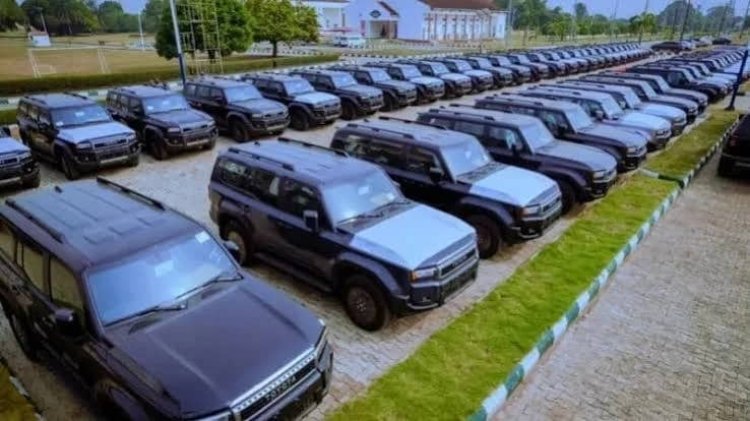
The Federal Government has earmarked ₦962.83 billion in the 2026 Appropriation Act for the procurement of Sport Utility Vehicles and empowerment projects. According to civic tech organization Tracka, this amount is more than the combined allocations to seven key federal ministries.
Tracka’s analysis shows the allocation is made up of ₦15.13 billion* for 39 SUVs and ₦947.70 billion for 2,579 empowerment projects.
The ₦962.83 billion is higher than the combined ₦960.27 billion budgeted for the Federal Ministries of Industry, Trade and Investment; Housing and Urban Development; Women Affairs; Justice; Livestock Development; Aviation and Aerospace Development; and Petroleum Resources.
The breakdown for those ministries is: Industry ₦156.8bn, Housing ₦145.3bn, Women Affairs ₦169.39bn, Justice ₦150.7bn, Livestock ₦177.6bn, Aviation ₦87.3bn, and Petroleum ₦73.1bn.
Tracka expressed concern over the lack of clarity around many of the empowerment projects. Only 70 out of 2,579 projects have clearly stated implementation locations.
The group asked how citizens can track projects with no location, how oversight institutions can verify them, and how taxpayers will know who benefits.
The projects are also spread across 184 implementing agencies, including institutions whose mandates do not cover empowerment. For example, Federal Cooperative College, Oji River got 393 projects worth ₦127.1bn. Federal College of Horticulture, Dadin-Kowa got 216 projects worth ₦88.1bn. Federal Cooperative College, Ibadan got 94 projects worth ₦36.9bn. The National Agricultural Development Fund got 6 projects worth ₦89.5bn.
The largest single allocation is ₦89.09 billion for the Renewed Hope Fertiliser Support Programme under NADF. Other big items include ₦14bn for empowerment equipment and utility vehicles through the Federal Cooperative College, Oji River, ₦14bn for youth empowerment under the Ministry of Youth Development, and ₦14bn for youth empowerment and medical outreach under the Ministry of Humanitarian Affairs.
The budget also includes allocations for buses, tricycles, motorcycles, sewing machines, fertilizers, vocational equipment, grants and other items.
Tracka said empowerment programmes are not bad. “When well-designed and transparently implemented, they can improve livelihoods and create economic opportunities.” But it warned that many in the past have become channels for political patronage because they lack clear locations, beneficiary selection, and are given to agencies without the right mandate.
The concern is heightened because the 2026 budget will be financed largely through borrowing, with a projected deficit of about 46%. Total spending is estimated at ₦68.32 trillion while revenue is projected at ₦36.87 trillion, leaving a deficit of ₦31.46 trillion. The borrowing plan for 2026 has been raised to ₦29.2 trillion.
The government also raised ₦5.08 trillion from the domestic bond market in the first half of 2026, a 77.8% increase from the same period in 2025.
Economists have warned about debt sustainability. Dr. Muda Yusuf of CPPE said high deficits and rising debt can “choke the fiscal space” and undo recent macroeconomic stability. Prof. Sheriffdeen Tella cautioned that empowerment spending should be structured to strengthen domestic production.
Former Vice President Atiku Abubakar also questioned why the government is borrowing heavily despite an estimated ₦7.98 trillion oil revenue windfall from crude prices above the budget benchmark.
Tracka called for more transparency: “Every budget item should have a clear purpose, a defined location, an implementing agency with the legal mandate, identifiable beneficiaries, and measurable outcomes.”