Petrol Price Climbs to N1,350 as Dangote Refinery and Marketers Clash Over Imports
By Victor Idajili
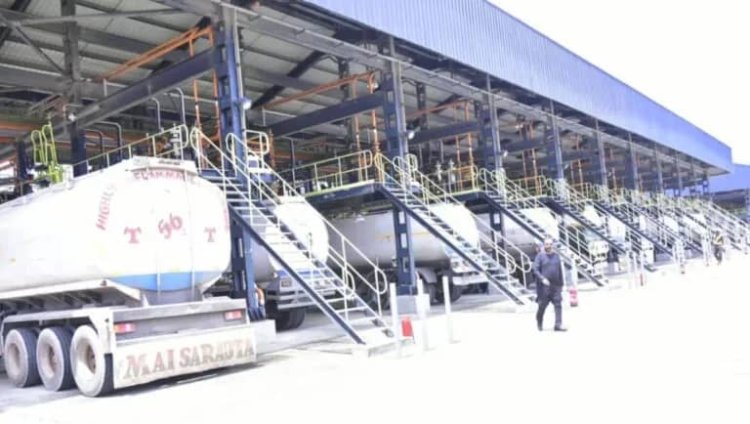
The dispute between Dangote Petroleum Refinery and major petroleum marketers has escalated, with the refinery considering restricting supplies to marketers who continue to import Premium Motor Spirit, popularly known as petrol.
The proposed action could take effect this week, depending on further consultations and any last-minute intervention. It comes as petrol prices surge nationwide and a litre now sells close to N1,400 in some areas.
Sources close to the refinery said the immediate concern is the alleged blending of imported petrol with products bought from the Dangote facility before they are distributed to consumers.
This has added another layer to the strained relationship between Nigeria’s largest refinery and oil marketers. Both sides remain divided on the role of imports in the downstream sector.
The refinery argues that continued importation undermines domestic refining and puts unnecessary pressure on local producers. Marketers, however, insist that imports are still needed to ensure adequate supply, encourage competition, and prevent a single supplier from controlling the market.
The disagreement has also raised fresh questions about the capacity of regulators to independently monitor the quality and specifications of imported fuel entering Nigeria.
According to sources familiar with the refinery’s position, there is concern that some marketers may be mixing imported petrol with locally refined product and selling the blend to the public. This, they said, makes it difficult to determine the actual source and quality of fuel on the market.
There is also worry that heavy investment in producing high-quality petroleum products could be undermined if those products are mixed with imports whose quality cannot be independently verified.
The refinery further flagged concerns about the availability of adequate laboratory and quality-control infrastructure for testing imported products, and about the regulator’s ability to independently certify the specifications of fuel entering the country.
The debate comes at a time when Nigeria’s dependence on imports is being questioned following the start of operations at the 700,000 barrels-per-day Dangote refinery, now the dominant domestic supplier. The refinery maintains that its products meet international standards and has increased both local supply and exports.
A recent report by the Nigerian Midstream and Downstream Petroleum Regulatory Authority showed that fuel imports remain significant despite rising domestic refining and exports.
The refinery has pushed for a stronger domestic refining framework, arguing that Nigeria should cut import dependence and conserve foreign exchange by processing crude locally.
Marketers counter that imports provide a competitive alternative and help prevent shortages, especially when local refineries face operational disruptions or cannot immediately meet demand.
The spat is happening amid another round of petrol price increases.
In Lagos, petrol now sells between N1,300 and N1,350 per litre, with some outlets approaching N1,400. Checks showed prices at various stations rose from about N1,280 to between N1,310 and N1,320 per litre.
Commercial drivers said the increase is hurting their earnings. One driver operating within Lagos said he spent N70,000 to buy fuel at N1,320 per litre and could only manage three trips for the day. Another driver said his daily fuel cost had risen from N12,000 to N32,000 for five trips, but fares have not been increased because passenger numbers are down. Others noted that after buying fuel, little is left from daily earnings.
In Kano, major stations adjusted prices from N1,285 to N1,310 per litre, while NNPC retail outlets moved from N1,285 to N1,305. Some independent outlets sold as high as N1,355 and N1,350 per litre. A motorist in Kano said the adjustment happened within hours.
In Abuja, some outlets were selling at about N1,350 per litre.
Rising crude oil prices have added pressure. Brent crude climbed above $90 per barrel on Monday, up from $88.57, amid renewed global tensions.
A major marketer dismissed claims that imported substandard petrol is being blended with Dangote-supplied product. The marketer described the proposed restriction as an attempt to stop imports and give the refinery greater control over the domestic market.
According to the marketer, the real issue is competition, supply and pricing. Demand for petrol drops when prices rise, and consumers are already cutting back. The marketer alleged the refinery wants to eliminate alternative supply sources in order to sell at higher prices, warning that this could amount to a monopoly.
The marketer also argued that imports remain necessary, pointing to operational challenges at the refinery in July which, according to the marketer, would have caused a bigger supply crisis without imported fuel.
Another marketer said the refinery stopped coastal loading to marketers three weeks ago and adjusted its gantry price three times between August 21 and August 29, 2026, for a cumulative increase of N100 per litre, roughly 8.6%, even as international crude benchmarks declined.
A petroleum economics expert said the allegations of blending and the regulator’s capacity to verify imported product quality should be independently established, not assumed.
He noted that the dispute goes beyond who imports or supplies petrol, and reflects a broader governance challenge as Nigeria moves from an import-dependent downstream sector to a domestic refining market.
According to him, Nigeria needs a regulator that ensures the best-performing market participant wins, not one that picks winners. The regulator must be independent, competent and properly equipped to enforce rules. The ultimate test, he said, is public value: regulation should deliver quality assurance, competitive prices, reliable supply, energy security and investment. Where regulatory gaps allow poor-quality products or market distortions, government failure becomes market failure, and consumers bear the cost.
The Nigerian Midstream and Downstream Petroleum Regulatory Authority said it has the sole responsibility to set quality parameters for all petroleum products supplied in Nigeria, whether locally refined or imported.
It added that, as a business, the refinery also has the right to choose its buyers under a willing buyer, willing seller arrangement.