2027: Jega Calls for Urgent Amendment to 2026 Electoral Act
By Victor Idajili
Former INEC Chairman, Prof. Attahiru Jega, says the 2026 Electoral Act needs urgent amendment ahead of the 2027 general elections, warning that some of its provisions could undermine electoral integrity.
Jega made the call on Wednesday in Abuja while delivering a paper titled _“Some Reflections on the 2026 Electoral Act and Nigeria’s Electoral Democracy”_ at the public presentation of _“A Collection of Essays: Readings on the Legislature”_ by policy expert, Prof. Ladi Hamalai.
While acknowledging that the law was designed to improve elections, he said it contains “issues of serious concern” and several “grey provisions” that must be reviewed to remove ambiguities and strengthen the law.
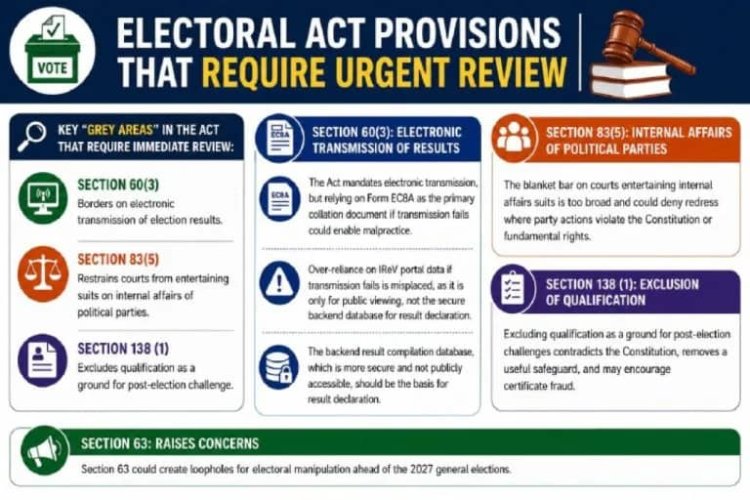
Jega flagged three sections for immediate review:
Section 60(3) – Electronic transmission of results: He commended the law for making e-transmission mandatory, but warned against the clause that makes the physical result sheet, Form EC8A, the primary collation document if e-transmission fails.
“Given Nigeria’s political environment and the desperation of ‘do-or-die’ politicians, there shouldn’t be such a vague provision… it could be used to abandon e-transmission for manual collation, which is easier to manipulate,” he said.
He also cautioned against over-reliance on the IReV portal for determining results in case of failure, noting that IReV data is for public viewing only. “The data to be relied on should be from the backend result compilation database, which is more secure,” he added.
Section 83(5) – Party internal affairs: Jega described it as a “sweeping generalisation” that bars courts from hearing cases on a party’s internal affairs. He questioned how courts could be shut out of disputes involving constitutional violations, fundamental rights, or the rule of law.
Section 138(1) – Post-election qualification: He faulted the removal of candidate qualification as a ground for post-election petitions. Citing Section 131 of the 1999 Constitution, which requires at least a school certificate to contest, he said: “There’s no rational justification for removing it, unless certificate fraudsters want an unrestricted field day.”
He noted that former INEC REC Mike Igini had also raised concerns over Section 63, warning it could enable manipulation in 2027.
Jega urged lawmakers to amend the Act within AU/ECOWAS protocols, which require electoral law changes at least six months before an election.
With INEC’s timetable putting the presidential/NASS elections on January 16, 2027 and governorship/state assembly polls on February 6, 2027, the six-month window has effectively closed. That leaves little room for changes before 2027.
Reforms for after 2027*
Looking beyond the next polls, Jega proposed deeper reforms drawn from the Uwais Electoral Reform Committee report:
INEC independence: Remove the President’s power to appoint the INEC Chairman and commissioners to avoid the “he who pays the piper calls the tune” perception.
Unbundle INEC: Let INEC focus only on conducting elections, while other agencies handle prosecution of electoral offenders, constituency delimitation, and party regulation.
Tougher party thresholds: Impose stricter legal requirements before parties can field candidates for governor and president.
Cut campaign spending limits: He described the current caps — N10bn for president, N3bn for governor, N500m for Senate, N250m for Reps, N100m for Assembly — as too high and a driver of vote monetisation.
On transparency and the judiciary
Jega said reforms must build public trust and boost turnout, but warned that “judicial rascality” by reckless judges is eroding confidence in elections. He called on the National Judicial Council to act swiftly.
“A good legal framework is necessary but not sufficient,” he said. “We also need democratic-minded politicians, an active citizenry, and institutions that act with integrity. All hands must be on deck to ensure the 2027 elections are conducted with integrity.”